
Space is hard.” It’s a common refrain among the orbitally inclined. The billionaire Richard Branson said it when Virgin Galactic’s SpaceShipTwo crashed in the Mojave Desert in the fall of 2014, killing one test pilot and seriously injuring another. The astronaut Scott Kelly said it last June, when a SpaceX rocket carrying...
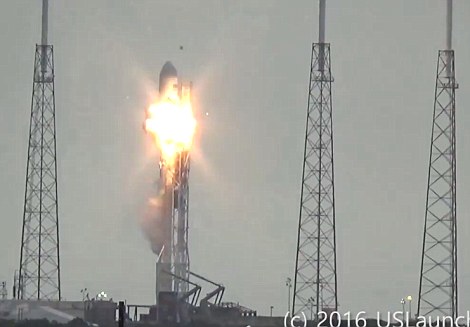
supplies to him and his colleagues aboard the International Space Station disintegrated in midflight. Charles Bolden, the administrator of NASA, said it this April, in a speech about the challenges of space exploration in the twenty-first century. On Thursday, the moment was right to spit-polish the adage and trot it out once again. At 9:07 A.M. that morning, during a pre-flight test, a rocket designed and built by SpaceX, a private aerospace company, exploded at Cape Canaveral Air Force Station, in Florida. A fireball emanated from the rocket’s second stage—the narrow neck just below the bulging payload at the top—and, fed by kerosene and liquid oxygen, consumed the rest of the vehicle. The area was clear of personnel at the time, as protocol requires, so there were no injuries. In the footage of the mishap, which SpaceX has called an “anomaly,” birds wheel through the sky and sing brightly as the rocket burns. Cape Canaveral abuts several wildlife refuges; presumably the fauna there have become accustomed to the thundering sound of human failure.
The
rocket, a Falcon 9 worth sixty-two million dollars, was totalled. By
the time the flames had died down, the skeletal structure of the launch
tower was blackened, like a drilling rig after a blowout. Nevertheless,
Elon Musk, the C.E.O. of SpaceX, was quick to tweet that the accident was “really a fast fire, not an explosion.” His remark may sound like blue-sky spin—what explosion isn’t just
a very fast fire?—but part of Musk’s point was that if this particular
rocket had carried a crew, as the Falcon 9 was conceived to do, they
would likely have had time to eject. As it was, the payload was
completely lost. It was an Israeli-built communications satellite called
AMOS-6, one of a range of satellites that convey TV,
radio, and Internet services to parts of Europe, the Middle East, and
sub-Saharan Africa. (AMOS-6 was due to replace AMOS-2,
which has been in orbit since 2003 and relays such channels as HBO
Romania, Hungary’s TV Paprika, and Hop!, a favorite among Israeli
preschoolers.) Some of AMOS-6’s bandwidth had been
reserved by Facebook for Internet.org, its initiative to bring Internet
access to connection-deprived parts of the world.
Mark
Zuckerberg, Facebook’s C.E.O., reacted to the news brusquely, pausing
between business meetings in Nairobi and a safari near Kenya’s Lake
Naivasha to berate Musk’s company. “I’m deeply disappointed to hear that
SpaceX’s launch failure destroyed our satellite that would have
provided connectivity to so many entrepreneurs and everyone else across
the continent,” Zuckerberg wrote in a post on Facebook. When a commenter
asked what kind of insurance plan might cover such an incident,
Zuckerberg responded that “the problem isn’t the money; it’s that now it
may take longer to connect Africa.” Later, he amended his statement,
changing “Africa” to “people,” as if to underscore that his ambition was
not merely continental but global.
The
edit also suggests that Zuckerberg has learned from past difficulties.
Last year, in India, he pushed hard to introduce a service called Free
Basics, which would have given people in the country complimentary,
though limited, Internet access, with Facebook (of course) at its
center. This February, the Indian government banned the service, calling
it a violation of net neutrality. At the time, the American blogger and
technologist Anil Dash advised Zuckerberg to “reckon with the history
of western corporate powers enforcing their desires on a broad swath of
the Indian population, especially India’s poorest.” There was a good
reason, he added, why “a colonialist ‘trust us, it’s for your own
benefit’ pitch is a hard sell.” Perhaps the SpaceX anomaly reminded
Zuckerberg that it’s more palatable to talk vaguely of “people.”
The combustion of AMOS-6 is bad for Facebook and Internet.org, but not fatally so. A month and a half ago, the company performed the first live test of Aquila,
an autonomous aircraft that will beam Internet to remote locations
using lasers. Aquila has the wingspan of a Boeing 737 but weighs a third
as much as a compact car, which means that it can fly quite slowly, at
what Facebook’s engineers call a “low-speed loiter.” This will allow it
to stay airborne for months at a time, flying high above clouds and
commercial planes, powered by the sun. Even without the new satellite,
Zuckerberg’s plans will move ahead. (Google has a similar program, which
will distribute Internet using thousands of high-altitude balloons. It
is called, aptly enough, Project Loon.)
The
prospects for SpaceX are less clear. Before Thursday’s anomaly, the
company had completed eight launches this year and planned for another
nine, with the ultimate goal of receiving NASA’s approval for a crewed mission late next year. It has a long list of
government and commercial customers waiting in line for rides to outer
space. So far, these prospective passengers don’t seem to be getting
antsy, since SpaceX’s over-all success rate is ninety-three per
cent—just less than the industry average—but a rushed investigation or
another accident could change that. Musk, meanwhile, may have to scale
back his dreams of galactic conquest. It had been rumored that he would
announce plans to build a city on Mars at the International
Astronautical Congress, in Guadalajara, later this month. Could the loss
of one Falcon 9 put the Mars Colonial Transporter mission on hold?
We’ll find out soon. Space is hard, even for the colonizers.